
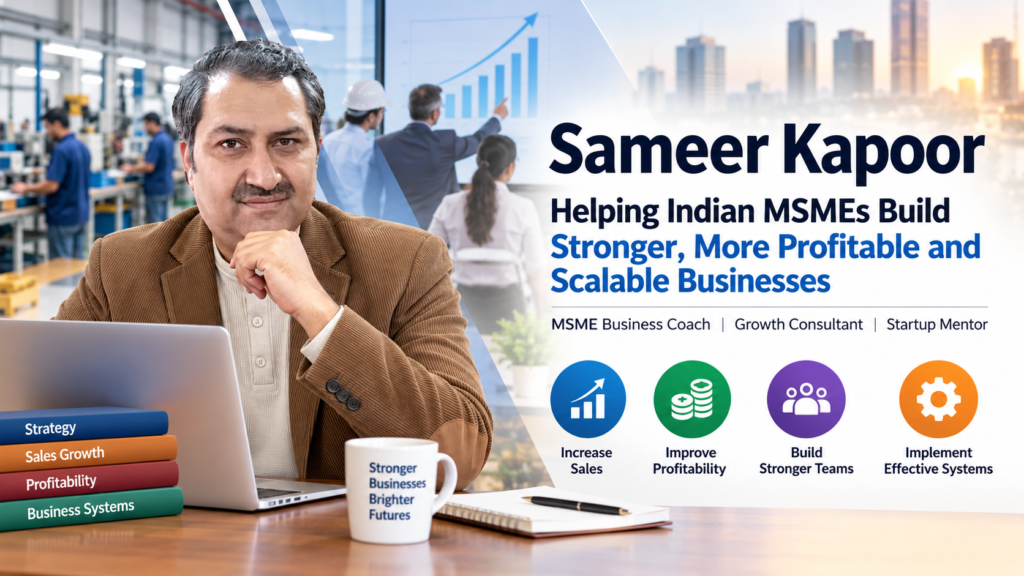
With over two decades of business consulting experience, Sameer Kapoor is helping entrepreneurs navigate growth challenges, strengthen business processes and build organisations that can scale beyond their founders.
India’s micro, small and medium enterprises (MSMEs) play a vital role in the country’s economic development. From manufacturing and distribution to financial services and technology, these businesses generate employment, serve diverse markets and create opportunities for entrepreneurship. Yet, as businesses grow, their challenges often become more complex. Increasing sales, maintaining profitability, building capable teams and implementing efficient systems require a level of strategic planning that many business owners struggle to manage alongside their daily responsibilities.
This is where structured business coaching and growth consulting can make a meaningful difference. Sameer Kapoor, an MSME business coach, startup mentor and growth consultant, works with entrepreneurs and business leaders to address these challenges through practical business strategy, organisational improvement and focused execution.
Understanding the Real Challenges of MSME Owners
For many entrepreneurs, starting a business is only the first milestone. Building a sustainable and scalable organisation presents a different set of challenges. A company may achieve respectable turnover but struggle with low margins, inconsistent cash flow, limited management capability or excessive dependence on its founder.
In other cases, sales may stagnate despite increasing marketing expenditure, employees may lack clarity about their responsibilities, or management decisions may be driven by intuition rather than reliable business information.
According to Kapoor’s approach to business growth, these problems should not be treated as isolated issues. They often reflect deeper gaps in business strategy, processes, accountability and management systems.
A business experiencing slow growth, for example, may not necessarily need a larger sales team. It may need better customer segmentation, a clearer value proposition, stronger lead management or an improved sales conversion process. Similarly, operational inefficiency may be linked to unclear responsibilities, inadequate performance measurement or the absence of standard operating procedures.
Identifying the underlying cause before recommending a solution is an important part of a structured business improvement process.
From Business Strategy to Practical Execution
One of the central challenges for MSMEs is converting business ambitions into measurable action. Business owners may have clear aspirations to increase revenue, expand into new markets or improve profitability, but these objectives require prioritisation, resources, accountability and consistent monitoring.
Kapoor’s consulting focus spans business transformation, organisation restructuring, product and proposition development, sales process improvement, management information systems (MIS), software and process overhauls, and digital growth.
These areas are closely connected. A sales strategy, for instance, must be supported by the right team structure, performance indicators, customer management processes and management reviews. Technology investments also need to serve clearly defined business objectives rather than becoming standalone projects.
For growing companies, this means moving beyond informal management practices towards a more disciplined operating model. Clear departmental responsibilities, measurable key performance indicators, regular review meetings and reliable management dashboards can help business owners identify problems earlier and make better-informed decisions.
The objective is not to introduce unnecessary corporate complexity into a small business. It is to create the minimum set of systems needed to improve control, consistency and scalability.
Building Businesses That Depend Less on the Founder
Founder dependency is a frequently overlooked barrier to MSME growth. In the early stages, entrepreneurs often manage sales, customer relationships, recruitment, finance and operations personally. This hands-on involvement can help establish a business, but it can become a constraint as the organisation expands.
When every important decision requires the owner’s approval, the company’s growth becomes limited by the founder’s time and capacity. Employees may hesitate to take ownership, customers may depend on direct access to the owner, and strategic priorities may be postponed because daily operational issues consume attention.
Business coaching can help owners recognise these patterns and develop a more structured approach to delegation, management development and performance accountability.
This may involve defining decision-making authority, establishing clear roles, introducing standard operating procedures, creating departmental scorecards and developing a second line of leadership.
The aim is not to remove the founder from the business. Rather, it is to help the founder transition from managing every activity to leading the organisation through capable people and effective systems.
Improving Sales, Profitability and Business Performance
Revenue growth is an important objective for most MSMEs, but sustainable growth requires more than higher sales figures. Businesses also need to understand customer profitability, product margins, working capital requirements, operating costs and the efficiency of their sales and delivery processes.
Kapoor’s business growth perspective emphasises the relationship between strategy and execution. A company seeking to increase sales, for example, should examine the quality of its leads, the effectiveness of its follow-up process, conversion rates, repeat purchases and customer retention. A business experiencing margin pressure may need to evaluate pricing, discounting, product mix and the cost of serving different customer segments.
Management information systems can play an important role in this process. A practical MIS dashboard enables business owners to monitor performance against targets, identify deviations and assign responsibility for corrective action.
When supported by regular management reviews, these systems can help organisations shift from reactive decision-making to a more proactive approach to performance management.
Supporting Business Transformation in a Changing Market
MSMEs increasingly operate in markets shaped by changing customer expectations, digital channels, new competitors and evolving technologies. Remaining competitive requires businesses to periodically reassess their products, customer propositions, operating models and routes to market.
Kapoor’s experience across business consulting and growth-oriented assignments provides a foundation for addressing these interconnected challenges. His areas of focus include improving business processes, strengthening organisational structures, refining product propositions and using digital channels to support business development.
Digital transformation, in this context, is not simply about adopting new software or increasing social media activity. It involves identifying where technology can improve customer acquisition, operational efficiency, reporting, decision-making and the overall customer experience.
For an MSME, the most effective transformation is often incremental and outcome-oriented: identify a business constraint, prioritise the right intervention, implement it with clear ownership and evaluate the results.
Business Coaching as a Structured Growth Process
Business coaching is most valuable when it goes beyond general motivation and provides a framework for better business decisions. Entrepreneurs benefit from an external perspective that challenges assumptions, helps clarify priorities and encourages consistent execution.
A structured coaching engagement can begin with an assessment of the business’s current position, including its growth objectives, organisational capabilities, operating challenges and management practices. The next step is to identify the most important constraints and develop an action plan with defined priorities and measurable milestones.
Regular reviews can then help the business owner evaluate progress, address implementation barriers and adjust the plan as market conditions change.
For some businesses, the priority may be building a more predictable sales process. For others, it may be improving profitability, strengthening management capability, implementing better reporting systems or preparing the organisation for expansion.
The specific interventions will depend on the business’s size, sector, stage of development and immediate objectives. A practical approach recognises that there is no single formula that works equally well for every enterprise.
A Focus on Sustainable and Scalable Growth
With more than 20 years of business consulting experience, Sameer Kapoor positions his work around helping businesses identify growth opportunities, address organisational challenges and translate strategic priorities into practical action. His professional focus spans MSMEs, startups and businesses operating across sectors such as financial services, SaaS, manufacturing and digital businesses.
His approach reflects an important principle of business development: growth is not simply about becoming bigger. It is about building an organisation that can generate sustainable results, serve customers effectively, manage resources efficiently and operate with greater consistency.
For Indian MSMEs seeking their next stage of development, business coaching and growth consulting can provide a structured way to examine existing practices, identify constraints and build the capabilities required for expansion.
As competition intensifies and business models continue to evolve, entrepreneurs who invest in stronger management systems, clearer strategies and more capable teams will be better positioned to pursue sustainable growth.
More information about Sameer Kapoor’s business coaching and consulting work is available at https://sameerkapoor.in/.